


















Table of contents
- What is a WordPress API integration?
- CRM & Sales API integrations
- Marketing & automation API integrations
- ATS & Recruitment API integrations
- Why choose a WordPress API integration?
- When do you need a custom WordPress integration?
- How we develop integrations
- Frequently asked questions about WordPress integrations
- Who are WordPress API integrations suitable for?
- Seamless API integrations with business processes
- Our approach to custom WordPress integrations
What is a WordPress API integration?
An API integration is a technical connection between WordPress and an external system or your own database. Through this connection, systems automatically exchange data without anyone having to intervene manually.
This can be one-way (for example, loading products), but it can also be two-way traffic (for example, leads being written back to a CRM). This ensures your website always remains current, error-free, and efficiently organized.
Examples of API-driven flows:
- Forms that automatically appear as leads in your CRM
- Job vacancies retrieved in real-time from an ATS
- Product data coming directly from an external database
- Stock and prices that always stay in sync
- Customer data processed securely in internal systems
In short: your website becomes smarter, faster, and more reliable, saving teams time and reducing errors.
CRM & Sales API integrations
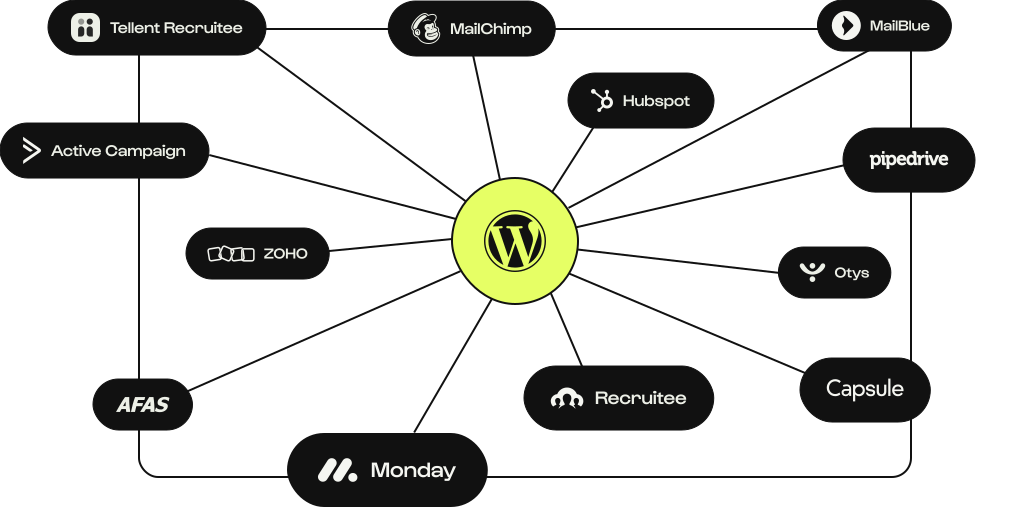
CRM systems such as Zoho, HubSpot, Capsule, Pipedrive, Exact, Monday, or Odoo ensure that all leads and customer data from WordPress are automatically collected and centrally managed. Form submissions, downloads, and other interactions on the website are sent directly to the CRM, where they can be followed up by sales or marketing. Some tools, like HubSpot, go beyond their core functionality and also support marketing by enriching and segmenting customer data for automated campaigns. These integrations create a single central data source for lead generation and follow-up, providing more insight, better timing, and higher conversion.
Marketing & automation API integrations
Marketing automation tools like HubSpot, ActiveCampaign, MailBlue, Mailchimp, MailerLite, Spotler, and Klaviyo are used via WordPress integrations to automatically follow up and convert leads. Form registrations, downloads, and other interactions are sent directly to these systems, where they are converted into targeted email campaigns, flows, and segmentation. Tools like HubSpot, Klaviyo, and ActiveCampaign also offer extensive options for personalization and behavior-driven communication, partially overlapping with CRM functionalities. This creates an automated marketing process that reaches leads at the right time and converts more effectively.
ATS & Recruitment API integrations
ATS systems such as AFAS, Recruitee, Otys, Teamtailor, and Carerix are used via WordPress integrations to automate and centralize recruitment processes. Vacancies, candidates, and applications are synchronized in real-time between the ATS and the website, ensuring your careers site connects seamlessly with your internal systems. Applications arrive directly in the ATS and can be followed up efficiently. These integrations result in a streamlined recruitment process with less manual work and a consistent candidate experience.
Why choose a WordPress API integration?
While a custom plugin adds functionality to WordPress, an API integration ensures the exchange of data between systems. It's not about a new feature on your website, but about an integration that automates processes.
A WordPress API integration ensures your website automatically works together with other systems — such as CRMs, ERPs, product databases, or marketing platforms. This keeps data current and makes processes more efficient. The result is less manual work, fewer errors, and a website that aligns seamlessly with your business operations.
From up-to-date product information and real-time stock to automatic lead processing: a good integration has a direct impact on speed, quality, and ease of use within your organization.

Ready for a smart integration?
Schedule a brief introduction. We'll discuss your systems, goals, and the best solution path.
When do you need a custom WordPress integration?
Not every organization can get by with standard plugins. As soon as your processes become more complex, you want to link multiple systems, or you depend on consistent and secure data exchange, you quickly end up with custom work. In these situations, a custom WordPress integration is the only solution that truly fits your workflow and ambitions:
- When no reliable plugin exists, or existing plugins don't connect to your systems.
- When security, performance, and continuity are important, and you don't want to depend on tools without an active development team.
- When you have specific or complex requirements that fall outside the capabilities of standard solutions.
- When data needs to flow back and forth without delay or errors.
When multiple systems need to work together in one integrated workflow. - When you want to automate processes so teams have less manual work and everything stays in sync.
Curious about an example? Check out our WordPress Mascus integration.
How we develop integrations
At Studio Brabo, we develop integrations that connect seamlessly with your systems, processes, and digital strategy. No plugin hassle, but custom work that is secure, fast, and future-proof. We combine technology, security, and performance with a clear process, so you know exactly what to expect. From initial concept to further development.
Understand & validate
We start with a functional analysis: what needs to be connected, how do processes run now, and which data needs to move in which direction? For complex projects, we create a Proof of Concept to test assumptions and minimize risks.
Security-first development
We develop a robust architecture that fits your infrastructure. Secure authentication, encrypted communication, and clear logging form the foundation. This keeps the integration reliable, scalable, and compliant.
Frequently asked questions about WordPress integrations
Short and clear answers to questions we often get. Is your question not listed? Feel free to contact us.
Costs depend on the systems, complexity, and desired data flows. In a brief introduction, we'll provide an estimate based on your situation.
In principle, yes, as long as the system has an API or can send data via webhooks. We connect WordPress to CRMs, ERPs, ATS systems, and industry tools every day.
Yes. Because we only build what is necessary, the integration remains lightweight, clear, and secure. No unnecessary permissions, no unknown codebase, and full control over updates.
An API integration is faster, more flexible, and more reliable. You aren't dependent on external developers, and data is processed exactly as your processes require.
Certainly. Many integrations are bidirectional, such as products being loaded and orders or leads being written back to the external system.
An API integration isn't always the best solution. If you work with simple processes, little data, or one standalone system, a standard plugin or manual workflow might be sufficient. As soon as automation doesn't offer a clear time or quality gain, custom work is often overkill.
Yes, that actually happens quite regularly. A custom plugin can serve as the technical shell within WordPress, while the API integration handles the data exchange with external systems. This keeps functionality clear and manageable while the integration remains secure and scalable.
Connect WordPress with your systems?
We'd love to think along. In a short call, we'll explore your situation and determine the smartest approach.
Who are WordPress API integrations suitable for?
WordPress API integrations are primarily suitable for organizations that don't see their website as a standalone marketing tool, but as an active part of their business operations. As soon as WordPress needs to work together with other systems — such as a CRM, ERP, ATS, or marketing platform — the need for reliable and scalable data exchange arises.
In practice, we often see this with marketing teams that want to work faster without manual tasks, organizations with multiple data sources, or companies that want to grow without processes becoming increasingly complex. Also, when multiple departments depend on the same data, or when errors in data have a direct impact on conversion, sales, or operations, a custom integration is the logical step. In those situations, a WordPress API integration provides peace of mind, oversight, and continuity.
Seamless API integrations with business processes
A website that perfectly aligns with your business processes? That's what you achieve with custom API links. Many companies work with CRMs, ERP systems, accounting software or other tools that need to work seamlessly with the website. We develop and integrate APIs that connect your systems and WordPress flawlessly.
- Automatic lead processing – Send completed forms directly to your CRM.
- Recruitment and HR tools – Connect vacancy pages to systems like Recruitee.
- Stock and product management – Synchronize your webshop with external databases.
- Payment systems and invoicing – From Mollie and Stripe to custom payment processes.
By building smart links, we automate processes, reduce manual work and create a more efficient workflow within your organization.
Our approach to custom WordPress integrations
Sometimes you need more than standard functionality in WordPress. Think of a webshop that automatically syncs inventory with your ERP, a lead generation platform that sends customer data directly to your CRM, or a custom tool that supports unique processes. In such cases, we develop custom WordPress links, plug ins and API integrations that fit seamlessly with your business processes.
But building a loose link into an existing Web site? We don't. We believe in an integrated approach, building the entire website or webshop from the ground up. This way, we make sure that everything works together perfectly technically and that performance remains optimal.
With this approach, we ensure that your WordPress website or webshop not only functions perfectly, but is also fully aligned with your business processes. Do you want to have a custom link built? Then we will only do that if we can also realize the entire website or webshop. This way we keep a grip on the quality and guarantee a solution that really works.
How our WordPress specialists work:
Inventory & strategy
We begin with an in-depth conversation to identify your needs, systems and goals. What does the link need to do? What data needs to be exchanged? How do we ensure a smooth user experience?
Proof of Concept (PoC).
For complex couplings, we first develop a proof of concept. This is a test setup in which we validate whether the intended link is technically feasible and functions optimally. In this way, we avoid surprises during implementation.
Technical feasibility & architecture
We explore the possibilities and choose the best solution. This can be an API integration, a custom plug in or a direct database link.
Development & implementation
Once the plan is in place, we build the link fully customized. We provide efficient, clean code that works quickly and securely within WordPress.