
Recruitment doesn't start with marketing, but with brand identity
A recruitment campaign is essentially nothing more than a promise: this is who we are and why you want to work here. If that promise isn't sharp, credible, or distinctive, it matters little how much you invest in visibility. People might click, but they won't apply. Why? Because candidates today are critical. They compare, research, and sense flawlessly when a story isn't right or feels generic.
You might reach people. But the real question is: do they respond, and more importantly, are they the right candidates? Without a sharp and distinctive brand, your message remains superficial. People scroll past or feel no real connection. And if they do respond, their profile often doesn't align well with what you're looking for.
The result: high reach, but little impact. You lose a lot of time while the right candidate stays away. Meanwhile, you keep investing in campaigns that yield too little, and the pressure on your team increases because they have to keep filling the gap.
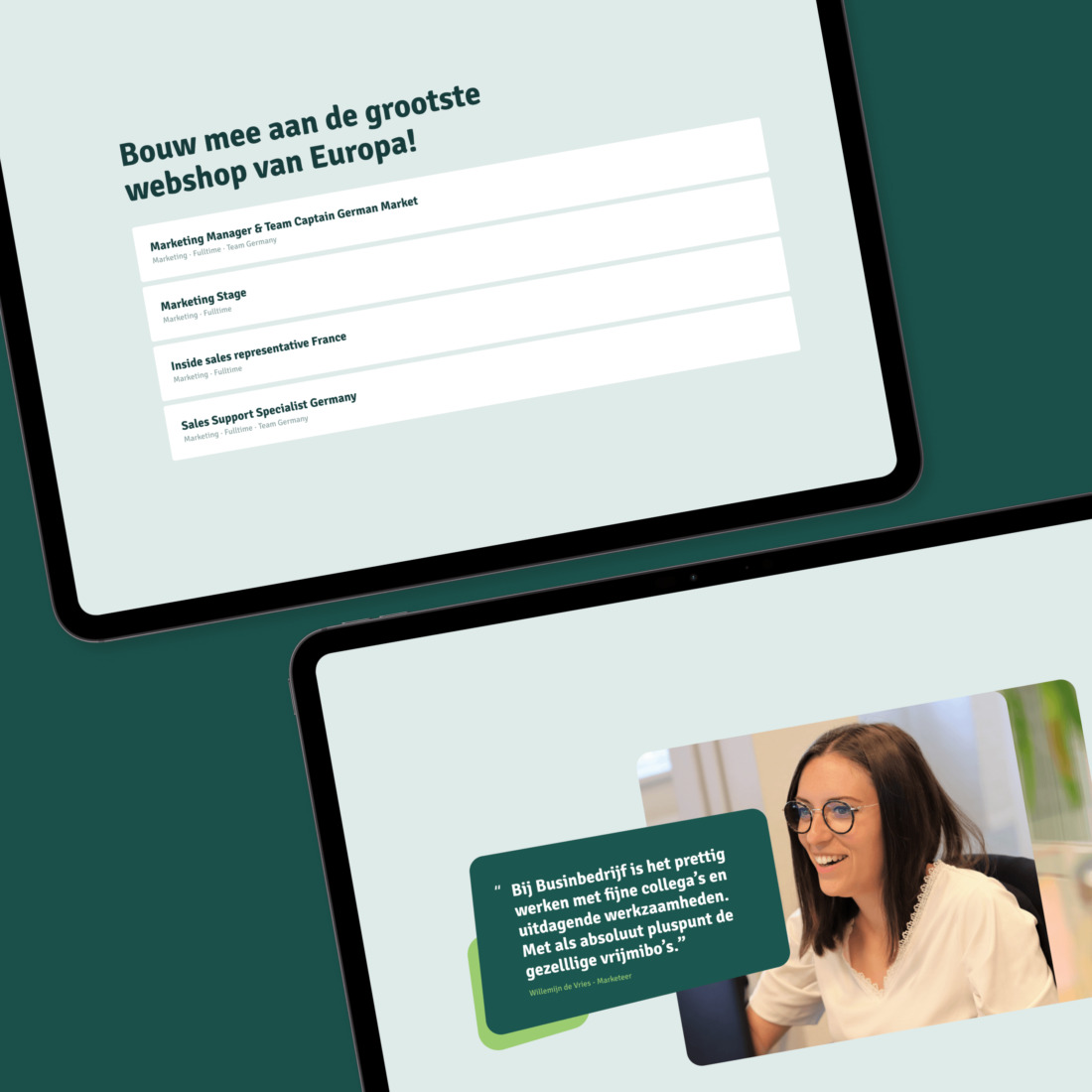
Work-at-site for
B2B webshop Vehikit
Studio Brabo's solution gives Vehikit the opportunity to beautifully highlight job postings with rich content and appeal well to different audiences.
What belongs in a strong employer brand?
A strong employer brand doesn't consist of isolated tools or a few nice job descriptions, but of a cohesive set of choices and expressions that reinforce each other.
- Sharp positioning: a clear and distinctive answer to the question of why someone wants to work here specifically and not at a competitor.
- Visual identity: so that all recruitment materials, from job ads to the careers website, immediately feel like part of the same brand rather than something separate.
- A credible tone of voice: no slick, generic copy, but language that fits the culture and the type of people you want to attract.
- Real-world proof: such as employee stories, concrete examples, cases, and atmosphere shots that show what it's really like.
- Consistency throughout the candidate journey: from the first ad to onboarding, the experience must match what you promise.
It is precisely that combination of strategy, look and feel, content, and experience that ensures an employer brand is not only attractive but also credible and effective in attracting and retaining the right people.


What a strong brand identity specifically does for recruitment
A strong brand identity doesn't just make recruitment more visible, but above all smarter and more effective. This is the direct impact on your inflow, experience, and results.
You attract better-fitting candidates
By clearly showing who you are as an organization and what you stand for, the right people specifically feel addressed. Candidates recognize themselves in your story, leading to better matches and less noise in your applicant pool.
Your story becomes more credible
A strong brand identity ensures consistency between what you say and what you show. As a result, your communication feels less like marketing and more like an honest and recognizable story, which increases candidate trust.

Looking for talent?
A recruitment website offers the perfect opportunity to strengthen your employer brand and attract the right talent. We'll help you make a powerful first impression.
From brand strategy to careers website and campaign
Once your brand values are sharp, they form the starting point for your communications. The careers website is a crucial translation of this: it's where everything comes together. It's the place where your employer story comes to life, where culture and projects become visible, and where potential candidates directly experience if they fit. At the same time, the site shouldn't just inspire but also activate, with a clear structure and a simple application process that removes obstacles.
Frequently asked questions about employer branding
While they are closely linked, they target different audiences:
- Corporate Branding: Focuses on customers and stakeholders to sell products or services.
- Employer Branding: Focuses on (potential) employees. It's about your reputation as an employer and the value you offer your staff.
EVP stands for Employee Value Proposition. This is the unique promise you make as an employer to your employees in exchange for their skills and commitment.
You start from the inside out. By first getting a clear picture of what's already there, you can translate that into a credible and distinctive story.
- Gather insights from employees: discover what they truly value about the culture and work environment.
- Define your EVP: make it concrete what makes you unique as an employer, such as flexibility, innovation, or growth opportunities.
- Translate this to your look and feel: ensure your careers website and other tools show this story consistently.
- Show it through real stories: use employees and their experiences as proof, instead of generic images.
In a crowded job market, candidates need an average of 7 to 10 touchpoints before they apply. If your job ads, LinkedIn posts, and careers site look different every time, you won't build recognition and trust.
You can measure success using various KPIs:
- Time-to-hire: Are vacancies filled faster?
- Cost-per-hire: Are advertising costs decreasing because people find you on their own?
- Retention rate: Do employees stay with the organization longer?
- Employee Referral: How often do current employees refer new colleagues?
The candidate journey is the path an applicant takes: from the first time they hear your name to their first day of work. Brand identity must be visible in every phase, for example:
- Awareness: A funny post on social media.
- Consideration: An in-depth interview with a team leader on the website.
- Application: A user-friendly application form that speaks the company's language.
- Onboarding: A welcome package that immediately delivers on the brand promise.
Yes, but from one clear foundation. Your brand identity remains leading, while you shift the focus per target group.
- Younger audiences often look for meaning, development, and flexibility, but above all expect what you say to be true.
- Experienced professionals look more critically at content: autonomy, the impact of their work, and the quality of projects play a larger role.
- Specialists (such as IT profiles) want to know specifically what they're getting into — think technology, workflow, and growth opportunities.
The core of your story remains the same, but you show different proof points and angles for each target group that are relevant to them.